Student Research Training Program (SRTP)
An SEU-funded project, SRTP aims to equip the undergraduate students with research experience and innovation abilities, and to help students in the four majors to explore the research frontiers. This program is classified into four levels, namely national-level, provincial-level, university-level and school-level. At higher level indicates more meaningful research and more funding.
University-level projects occupied the largest proportion each year, which represents the average condition of SRTP projects in SCE. School-level projects are less than the university-level projects. The number of national-level projects is around 12 in each of the past five years, while the number of provincial-level projects fluctuates around 15.
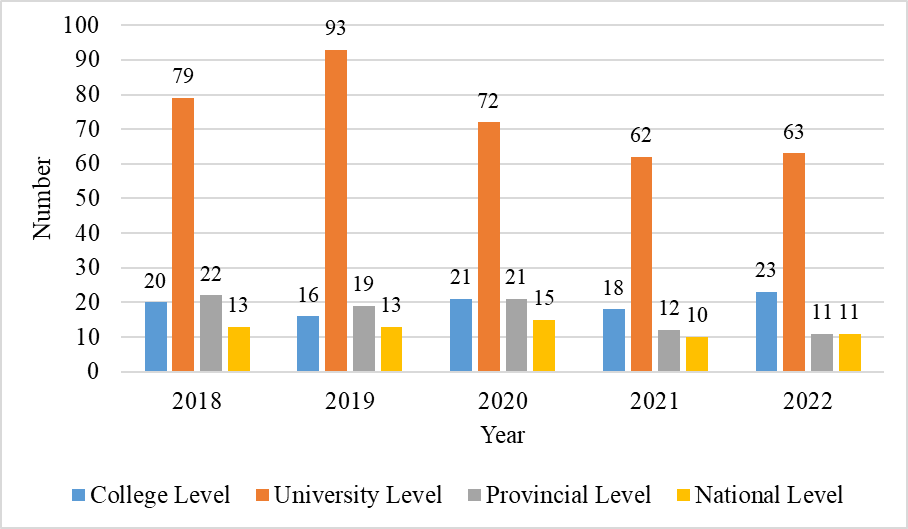
Statistics of SRTP projects in recent years
The ratios for Civil Engineering, Construction Engineering, Engineering Mechanics, and Water Engineering are 66%, 21%, 5%, and 8%, respectively. These ratios are consistent with the number of students in each major.
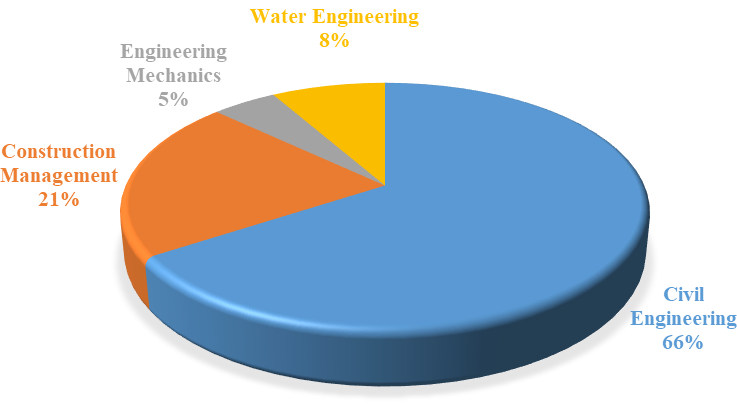
Ratios of different SRTP subjects from 2018 to 2022
The follwing picture presents a typical SRTP achievement reported by the famous public media platform Xinhua (www.news.cn). This achievement is an intelligent openable roof system for large-expanse structures. The openable roof is realized by the folding and rotational type open-close method. Sensors are installed on the roof surface to identify the environment condition, making the roof truly "intelligent". The open state can be adjustable according to the surrounding perceptual conditions, such as temperature, sunshine, and rain.
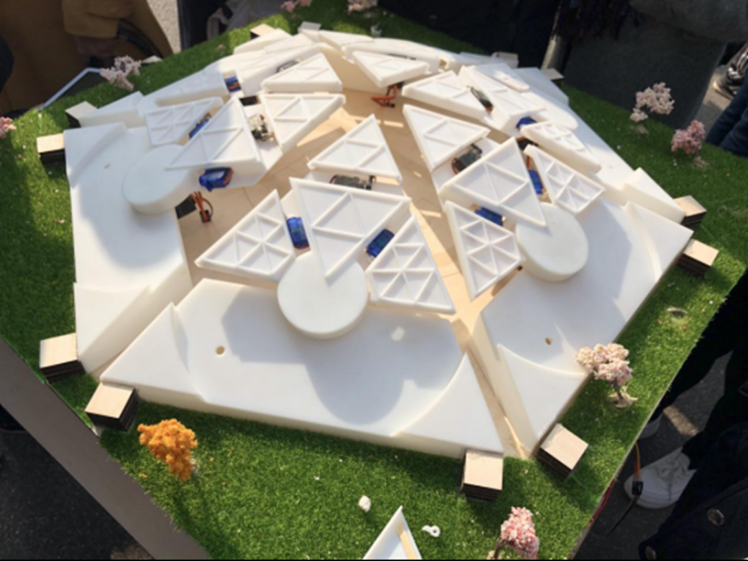
A typical SRTP achievement
Attendance of International and Domestic Competitions
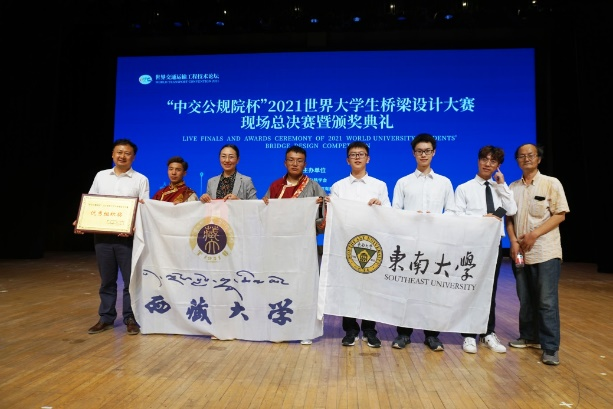
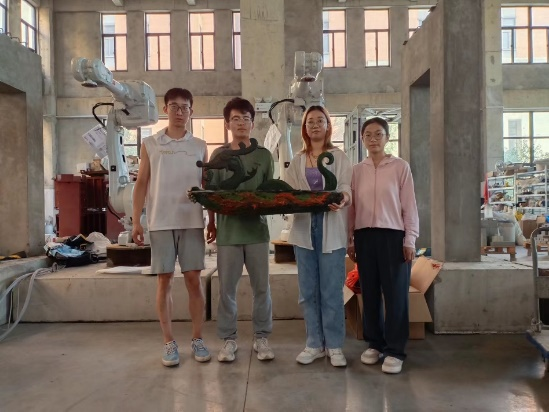
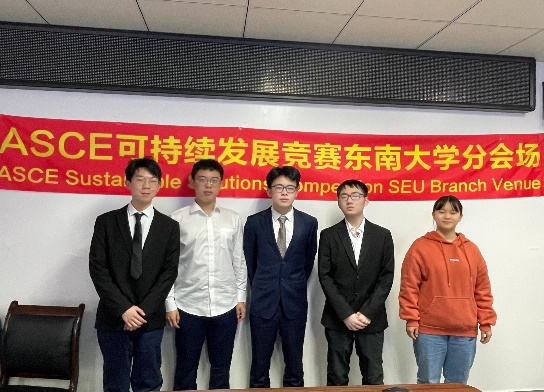
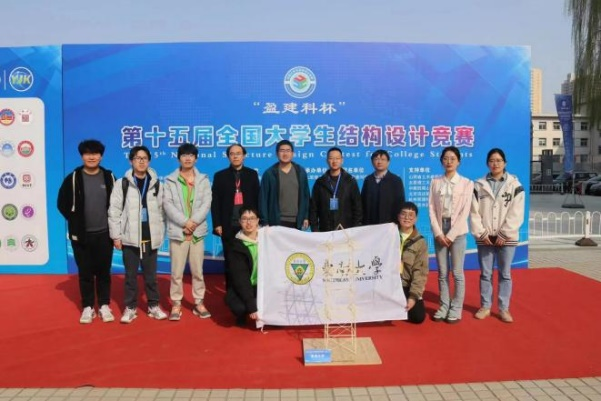
SCE students have been very active in attending international and domestic civil engineering competitions, such as those held by American Society of Civil Engineers (ASCE; including the Steel Bridge, Concrete Canoe and Sustainable Solutions Competitions), the World University Bridge Competition, Concrete Dragon Boat Competition and the National Structural Design Contest.
|
|
(a)2021 World University Bridge Competition | (b)2022 Concrete Dragon Boat Competition |
|
|
(c)ASCE Sustainable Solutions Competition | (d) 2023 National Structural Design Contest |
Typical competitions SCE students attended in recent years
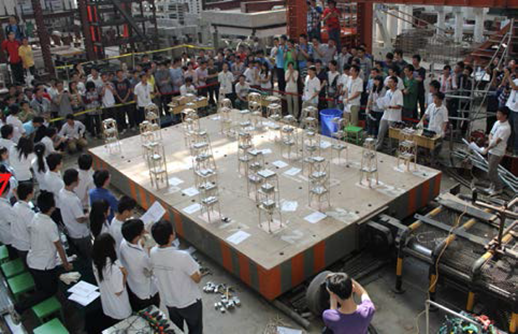
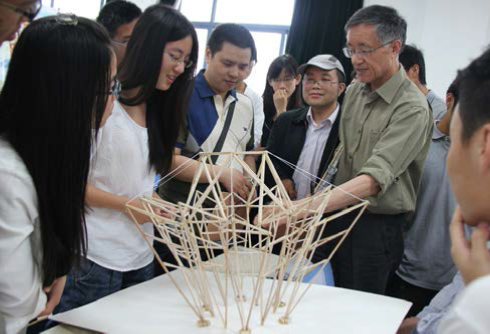
To train the practical skills and innovation ability of SCE undergraduate students, structural competitions are organized by SCE every year. The competitions are specified for students in different grades, and the talented students will be accordingly selected to attend the provincial, national and international competitions.
|
|
(a) Seismic resistant design competition | (b) Innovative structural design competition |
Some competitions organized by SCE
The number of awards achieved from 2018 to 2022. Example of an international award achieved is the 2022 ASCE Sustainable Solutions Competition where SCE students won second place. Example of a national award achieved is the 2019 National Structural Design contest, which involved more than 100 universities, where SCE students were the meritorious winners. For provincial awards, the total number of awards achieved from 2018 to 2022 has reached 52.
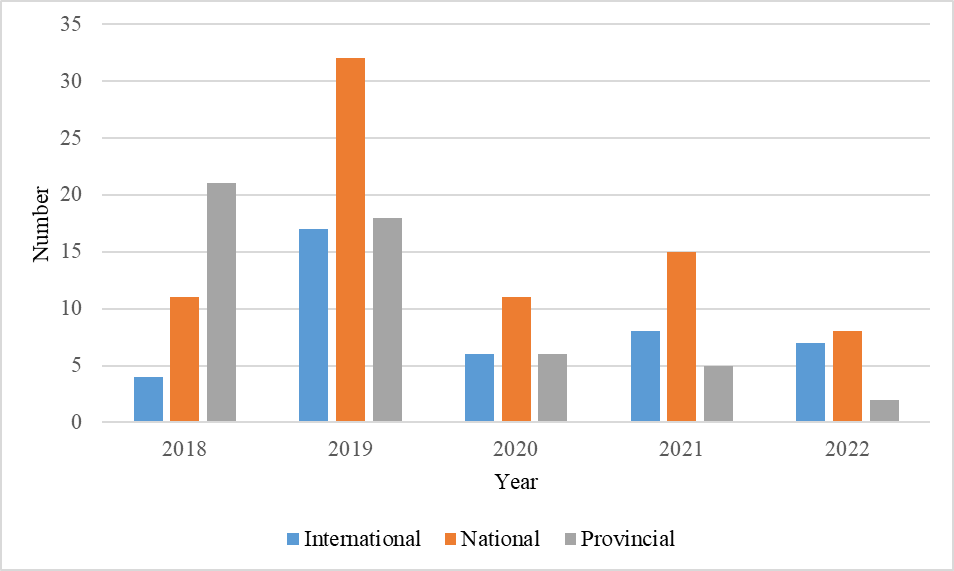
Statistics of awards received in competitions from 2018 to 2022
It is found that Civil Engineering accounts for the largest proportion (46%), followed by Engineering Mechanics (35%). For Construction Management, the percentage is 16%, and the percentage of Water Engineering is the smallest (3%). Since many students in Civil Engineering attend the engineering mechanics competitions as well, the awards of Engineering Mechanics rank No.2 with a relatively large proportion.
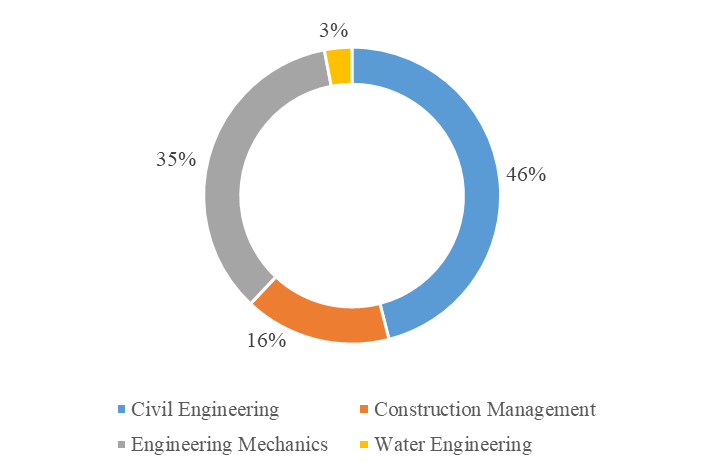
Distribution of awards in each subject in the past five years
Some typical competitions are introduced below:
(1) International Engineering Mechanics Contest, 2019, China
Award level: Gold award in the team competition (First place)
Participants: Zhou Chongbo, Wang Jinyang, Meng Shengguo
Supervisors: Gu Chengjun, Jiang Yijun, Wang Wenjie
Introduction: The competition aimed to improve the knowledge level and application ability of university students and to promote international exchange. It not only examined the achievements of mechanics education in various countries but also improved the overall level of international mechanics education. The competition was divided into team competition and individual competition. The individual competition included eight problems with a total of 240 testing minutes. The team competition had 30 questions in total. Both individual and team competitions consisted of three parts: statics, kinematics and dynamics. Both the supervisors and students can provide novel solutions, which is a relatively new and effective teaching method.
(2)2nd International College Student Invitation Competition of Technology Simulation for High-speed Railway Construction, 2019, China
Award Level: Outstanding Winner
Participants: Zhao Kaiyong, Zhu Xinghu, Zhu Xuerong
Supervisor: Tao Tianyou
Introduction: This model consisted of truss beam and piers, worked as a simply supported beam. To ensure strength under vertical loads, truss girder was designed and right-angled trapezoid section was chosen for the piers. Simultaneously, four longitudinal beams were connected with the cross beams while the deck was laid on the cross beams so as to keep the structure stable in the transverse direction. The girder was overlapped above the piers depending on the cushion block, which was used to simulate the sliding isolated bearing. Meanwhile, to prevent large displacement of the girder under seismic actions, the longitudinal and transverse limiting blocks were set both at the bottom of the beam and at the top of the piers, respectively. The loads travelled to the ground in a clear and simple way through the model, while the isolated bearings performed well under seismic actions.
(3) 13th National University Student Structure Design Competition, 2023, China
Award level: First Prize
Participants: Zheng Jihai, Li Mengmei, Xing Ze
Supervisors: Sun Zeyang, Qi Jianan
Guidance teacher: Lu Jinyu
Instruction: This structural design competition entitled Design and Fabrication of Mountain Transmission Tower Model required model design and loading tests under 16 random loading conditions. The model adopted the mast structure and consisted of two compression members and eight cables. The bottom of the compression members was hinged to reduce bending moment. The reduction of horizontal distance between the high and low hanging points reduced the model torque. This model transmitted the load to the base plate in the shortest path of force transmission. For compression members, shuttle-shaped lattice columns were used to improve its ability to prevent instability. While reducing its weight, it also greatly improved the bearing capacity; for local components, a fuse was innovatively designed so that it took the lead in active damage when bearing extreme loads to ensure safety of the main structure.
(4) International Concrete Dragon Boat Competition, 2022, China
Award Level: First Prize
Participants: Zheng Xiaofeng, Zheng Chenyang, Zhang Yu, Li Chenjing
Supervisors: Tao Tianyou, Wu Chang, Wang Hao
Introduction: The team won the first prize in the International Concrete Dragon Boat Competition held in 2022, China. The competition required the students to use concrete as the basic material to build a dragon boat with traditional Chinese cultural characteristics for the Chinese Dragon Boat Festival. The competition required the participating teams to have knowledge of structural materials and design, analysis and construction, application of automatic control, as well as creative thinking, interdisciplinary collaboration skills and artistic design ability. It was a comprehensive competition that integrated innovation with multi-disciplinary knowledge such as materials, ship building, civil engineering, electromechanical, and fine arts that involve traditional Chinese culture with modern science and technology. The competition included six parts: aesthetics design, technical papers, strength test, work display, straight line racing and corner racing. Each participating team had to compete in each part to be judged for the final total score.

School of Civil Engineering, No.2 Southeast University Road,
Jiangning District, 211189, Nanjing, Jiangsu Province, P.R China
025-52091227
admin_civil@pub.seu.edu.cn

CopyRight © School of Civil Engineering 2012-2020